
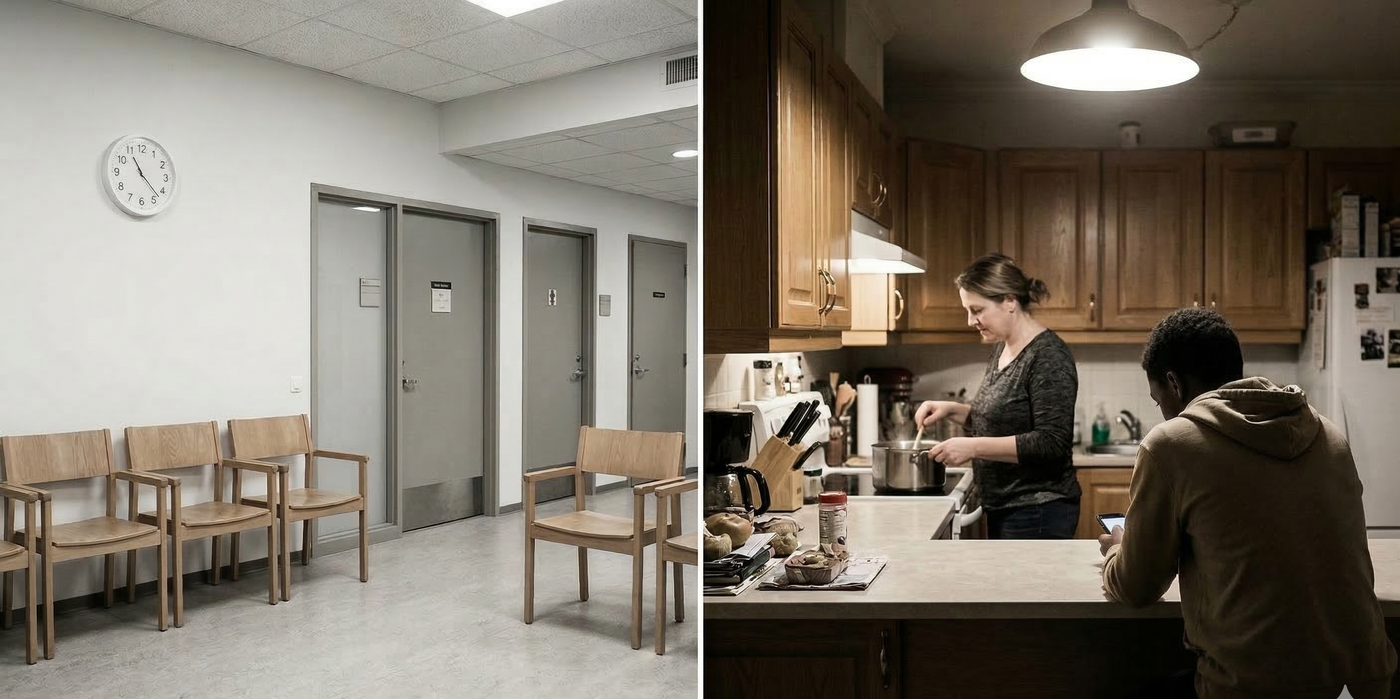
Higher levels of care exist for a reason. Sometimes youth need them. Sometimes safety requires it. I am not here to pretend otherwise.
But I am here to tell the truth about what I have seen.
Higher level does not always mean better.
In theory, residential settings and group homes provide structure, supervision, and services. In reality, many of these settings are stretched thin. Staffing changes. Relationships are inconsistent. Youth learn to survive environments, not to build healthy attachment.
For teens, that inconsistency can make everything worse.
It reinforces what they already believe. Adults do not stay. Rules change. Nothing is stable.
And when youth do not experience stable relationships, therapy does not land the same way. Skills do not stick the same way. Consequences do not teach the same way.
A teen can follow rules in a program and still fall apart in real life. That is because life is not a program.
Life is a home. A family. A school day. A conflict with a peer. A bad mood. A disappointment. A boundary. A morning where you still have to get up and go.
That is why family-based stability matters.
Not every teen needs escalation. Many teens need the right support in the right environment.
Sometimes what a teen needs is a home that can hold structure without breaking relationship. A home that does not confuse accountability with rejection.
A home where expectations are clear. School participation matters. Chores matter. Respect matters. Honesty matters. And when the teen struggles, the response is consistent.
That kind of environment can prevent escalation, but only if the caregiver is supported and the model is designed for reality.
Too often, systems use higher-level care as a default because it feels safer on paper. But the long-term results are not always better, and the cost is often far higher.
What gets missed is the gap in the middle.
Traditional foster homes can be overwhelmed. Residential placements can be too institutional. Teens who could stabilize in a structured home end up bouncing because there is not a model designed for them.
That gap is exactly why we created our Foster Home Hybrid approach. Not to replace anything, but to fill the space where too many teens fall through.
The goal is simple.
Keep teens in homes whenever possible, with structure and support strong enough to hold under stress.
That is how you reduce moves. That is how you reduce crises. That is how you create real outcomes.